
Criminal Court Records in Jackson County
A criminal court record is the case file opened when the State of Oklahoma charges someone with a crime. The Court Clerk keeps it. Each filing, order, and hearing goes into that one file. In Jackson County, the Court Clerk is the keeper of the permanent District Court record. The office collects fines, fees, and costs, and holds the public court files. It sits in the Jackson County Courthouse in Altus. Most criminal files are open to the public. A few are sealed by law, and those stay closed. The broader set of civil, family, and traffic files appears across the county's court records.
Jackson County criminal cases are heard in the District Court. This is the main trial court for Jackson County. It handles both felony and misdemeanor matters. A felony is the more serious class of crime. A misdemeanor is the lesser class. Case numbers signal the type. Felony files use the CF prefix, and misdemeanor files use CM. City ordinance tickets are different. Those go to the Altus Municipal Court, not the District Court. Appeals from a criminal conviction route to the Oklahoma Court of Criminal Appeals, the state's top court for criminal matters.
How to Search Jackson County Criminal Court Records
The fastest way to find a Jackson County criminal case is an online search. Two state systems carry District Court data. On Demand Court Records, known as ODCR, lists Jackson in its court dropdown. The Oklahoma State Courts Network, or OSCN, also publishes docket information. Both are free to search. Neither one replaces the official file held by the clerk.
- Open the ODCR search page, pick "Oklahoma District Courts," then choose Jackson from the court list.
- Search by the defendant's name, entered as Last, First, or by the full case number.
- Narrow the results by case type, such as Criminal Felony or Criminal Misdemeanor, and by filed date if needed.
- Open the case to read the docket, the charges, and the disposition.
- Request a certified copy from the Court Clerk when you need a document for legal use.
Names are entered last name first. A case-number search is faster when you have the number. Oklahoma numbers begin with a prefix, like CF for felony and CM for misdemeanor. You can also filter by case type to cut a long list down. For older paper files or a sealed-record question, the clerk is the better path.
Note: An online search that finds nothing does not prove a case never existed, since older Jackson County files may live only on paper at the clerk's counter.
Who Prosecutes Jackson County Criminal Cases
Criminal charges are brought by a prosecutor, not by the police. In Jackson County, that prosecutor is the District Attorney for District 3. District Attorney Dan Jacobsma leads the office. District 3 covers Jackson, Greer, Harmon, Kiowa, and Tillman Counties. The local office sits in the Jackson County Courthouse in Altus. The DA reviews the police report and decides what to file. The DA can amend a charge, dismiss it, or decline to file at all. In every state case, the record names the State of Oklahoma as the party against the defendant.
Not every crime is a state case. Some are federal. Crimes that break federal law are handled by the U.S. Attorney's Office for the Western District of Oklahoma. The U.S. Department of Justice posts a profile for the district's top federal prosecutor.
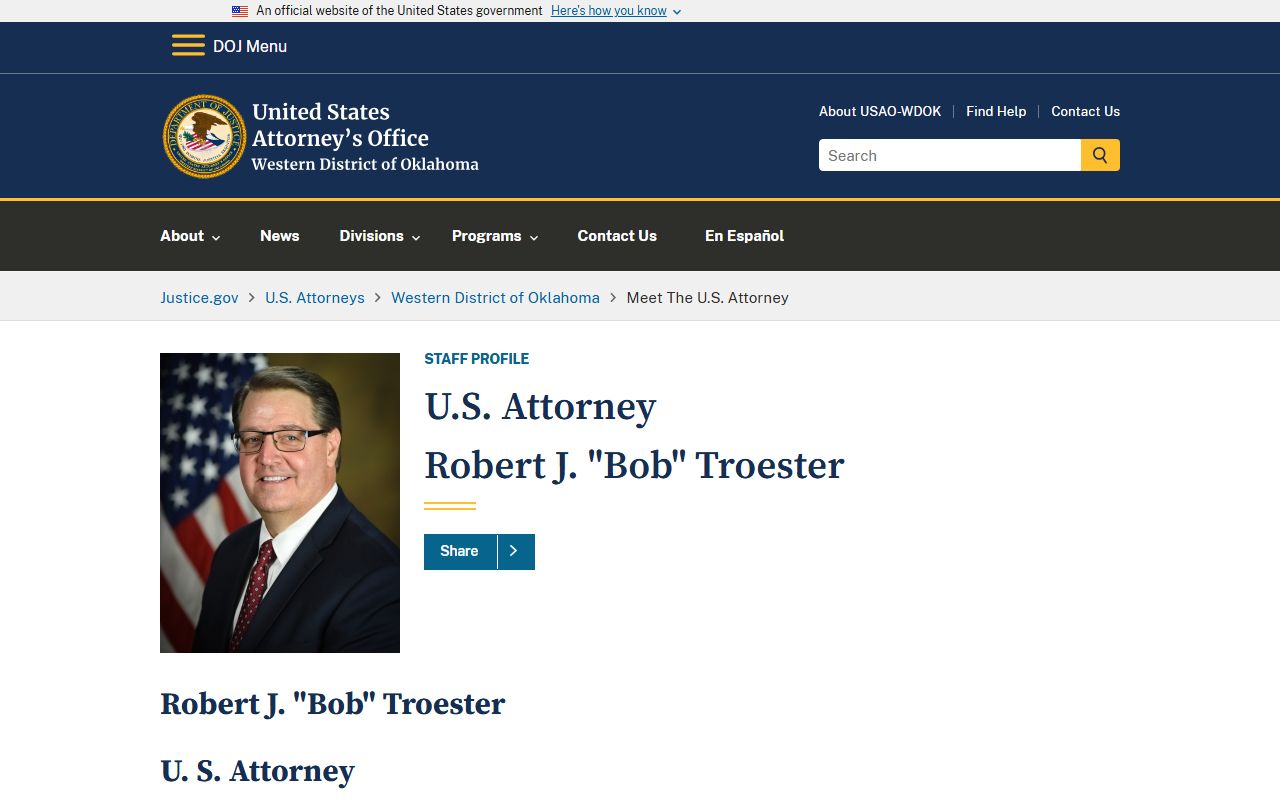
That office prosecutes federal criminal and civil matters across a 40-county district. Its cases never show up in the county or state court search. A defendant who cannot afford a lawyer may be assigned counsel by the court through the Oklahoma Indigent Defense System after a finding of need.
Stages of a Jackson County Criminal Case
A Jackson County criminal case moves through set steps. Each step leaves a mark in the file. The record grows as the case goes on. Reading the docket in order shows where a case stands today.
Case flow: Charges Filed › Arraignment › Pretrial / Motions › Plea or Trial › Disposition › Sentencing
- Arraignment: The charges are read in open court, and the defendant enters a plea of guilty, not guilty, or no contest.
- Pretrial and motions: Lawyers exchange evidence and file motions, and the judge rules on what a jury may hear.
- Plea or trial: The case ends in a negotiated plea, or it goes to trial before a judge or jury.
- Disposition and sentencing: After a guilty plea or verdict, the judge sets the punishment, which may include jail, fines, or probation.
What a Jackson County Criminal Court Record Shows
The case file is built from many fields. Each one answers a basic question about the case. Public search results show most of them. These core fields appear in nearly every Jackson County criminal court record.
| Field | What It Shows |
|---|---|
| Case Number | The unique ID, such as CF-2023-45, with a prefix for the case type and the filing year. |
| Defendant | The person charged, listed against the State of Oklahoma. |
| Charges | Each offense filed, tied to a statute and a severity level. |
| Plea | The defendant's formal answer, such as guilty, not guilty, or no contest. |
| Disposition | The outcome of each charge, such as convicted, dismissed, or deferred. |
| Sentence | The punishment set after a conviction, listed by term, fine, and conditions. |
A criminal file also tracks bonds, warrants, motions, and any failure to appear. Financial fields show fines, costs, restitution, and any payment plan. Some data is masked. Social Security numbers, account numbers, and a minor's full details are kept out of the public view.
Note: Documents may be viewable online in some Oklahoma case systems, but a certified copy must come from the Jackson County Court Clerk in Altus.
Charges vs. Convictions
Being charged is not the same as being found guilty. A charge is only an accusation. A conviction is a final finding of guilt by plea or verdict. A criminal court record can show charges that were dropped, dismissed, or that ended in an acquittal. None of those is a conviction. The status of each charge, and how it can change, is laid out on the Jackson County arrest records and charges page.
| Charge | Conviction | |
|---|---|---|
| Stage | Accusation | Verdict or plea |
| Burden of Proof | Probable cause | Beyond reasonable doubt |
| Public Record | Yes | Yes |
Reading Dispositions and Sentences
In a Jackson County case, the disposition is the outcome line in the file. It tells you how each charge ended. Common entries are guilty, not guilty, and dismissed. A no contest plea, called nolo contendere, accepts the punishment without admitting guilt. A case can also be dismissed with or without prejudice. Dismissed with prejudice means it generally cannot be refiled.
Oklahoma also uses deferred and suspended sentences, and they read differently. A deferred sentence holds off a finding of guilt. If the person meets the court's terms, the case may be dismissed later. A suspended sentence is a conviction, but the jail or prison time is held back under conditions. The sentence line shows the term, the fines, and any probation. The same file lists costs and restitution owed.
Sealed vs. Expunged Records
Some Jackson County criminal records can be sealed or wiped. Oklahoma offers two main paths, and they are not the same. A sealed record is hidden from the public but still exists. An expunged record is treated as if it never happened. The Oklahoma State Bureau of Investigation explains how each one works.
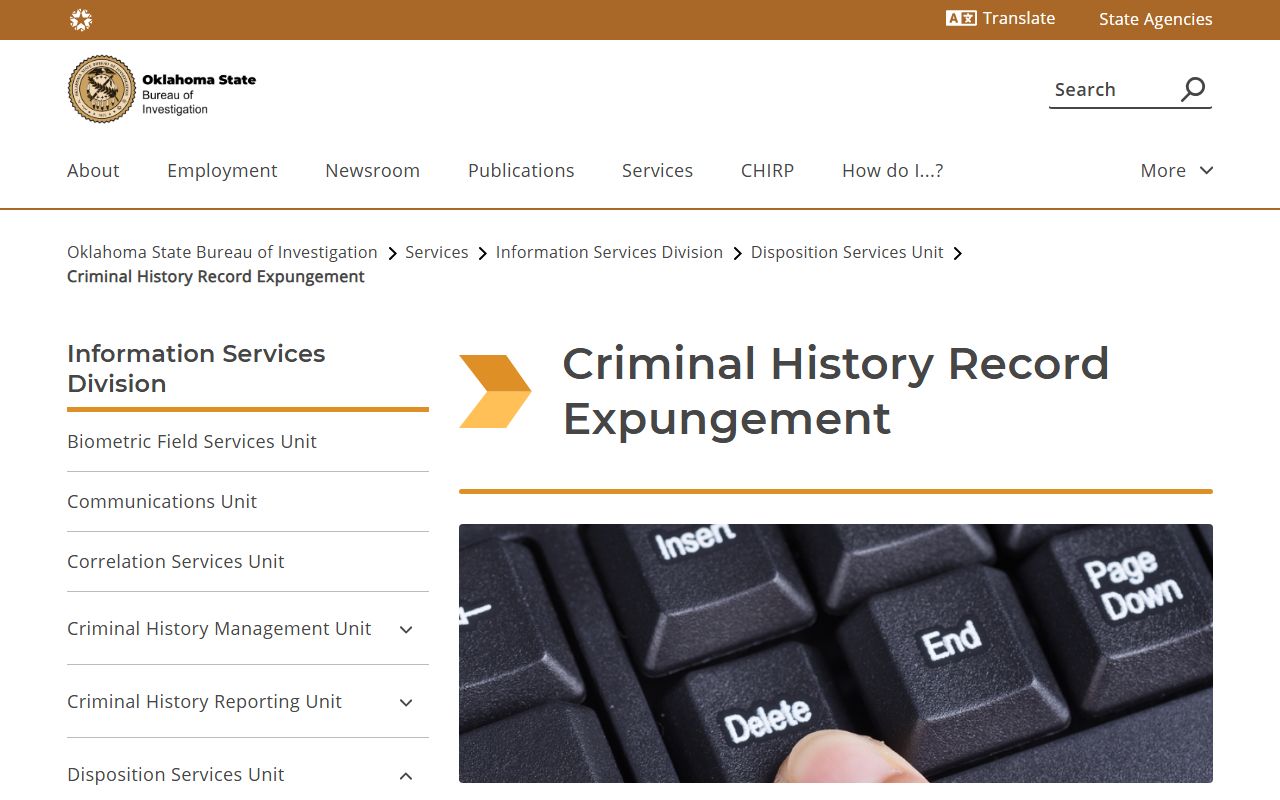
Under Title 22, Section 18, a full expungement can remove the entire arrest record when a person qualifies. A Section 991(c) expungement applies to a deferred sentence. It updates the case to show a not-guilty plea and a dismissal, but it does not erase the arrest record. The cost depends on what you clear. The OSBI says expunging the court record is free. Expunging the arrest record requires a $150 processing fee paid to the OSBI, and local law enforcement may charge its own fee. The case starts in District Court, where a judge must sign the order before the clerk and the agencies seal the file.
| Sealed | Expunged | |
|---|---|---|
| Visibility | Hidden from public | Destroyed / treated as never existed |
| Law Enforcement | Limited access | Very limited |
| Eligibility | Court order under Title 22 | Qualifying arrests and deferred sentences under 22 O.S. § 18 |
Public Access to Jackson County Criminal Court Records
Court records in Oklahoma are open by default. State law treats government records as public unless a specific rule makes them confidential. Jackson County criminal files follow that rule. Ordinary felony, misdemeanor, and traffic files are open for inspection. Juvenile, adoption, guardianship, and mental health files are the main exceptions.
Key Statutes:
Oklahoma Statutes Title 51 § 24A.5 - Public records are open for inspection and copying during business hours unless a law makes them confidential.
OKCCA Rule 2.6 - The OSCN online case search is a convenience tool and does not replace the official court record.
Federal criminal matters from Jackson County are a separate track. The U.S. Attorney's Office for the Western District of Oklahoma posts news on the federal cases it brings.
Federal files are not in the county or state portals. They are reached through the federal PACER system instead. So a full Jackson County criminal history may span both the District Court file and a separate federal record.
Background Check Considerations
Many people search Jackson County criminal records to vet a job seeker, a tenant, or a date. A casual lookup is fine for personal knowledge. A formal background check for hiring or housing is different. Those are governed by the federal Fair Credit Reporting Act. They must run through a licensed screening firm that follows the law.
Important: This site is not a consumer reporting agency under the FCRA, and its information may not be used to make credit, employment, tenant, or insurance decisions.
Restricted Criminal Court Records in Jackson County
Some Jackson County criminal records stay closed. Juvenile cases are confidential under Oklahoma law. Adoption, guardianship, and mental health files are also held back. Sealed and expunged cases drop out of public view. An open investigation may keep records out of reach until charges are filed. When a file is restricted, the online search will not show it, and the clerk cannot release it without legal authority. For a clear answer on a specific case, call the Court Clerk at 580-482-0448.